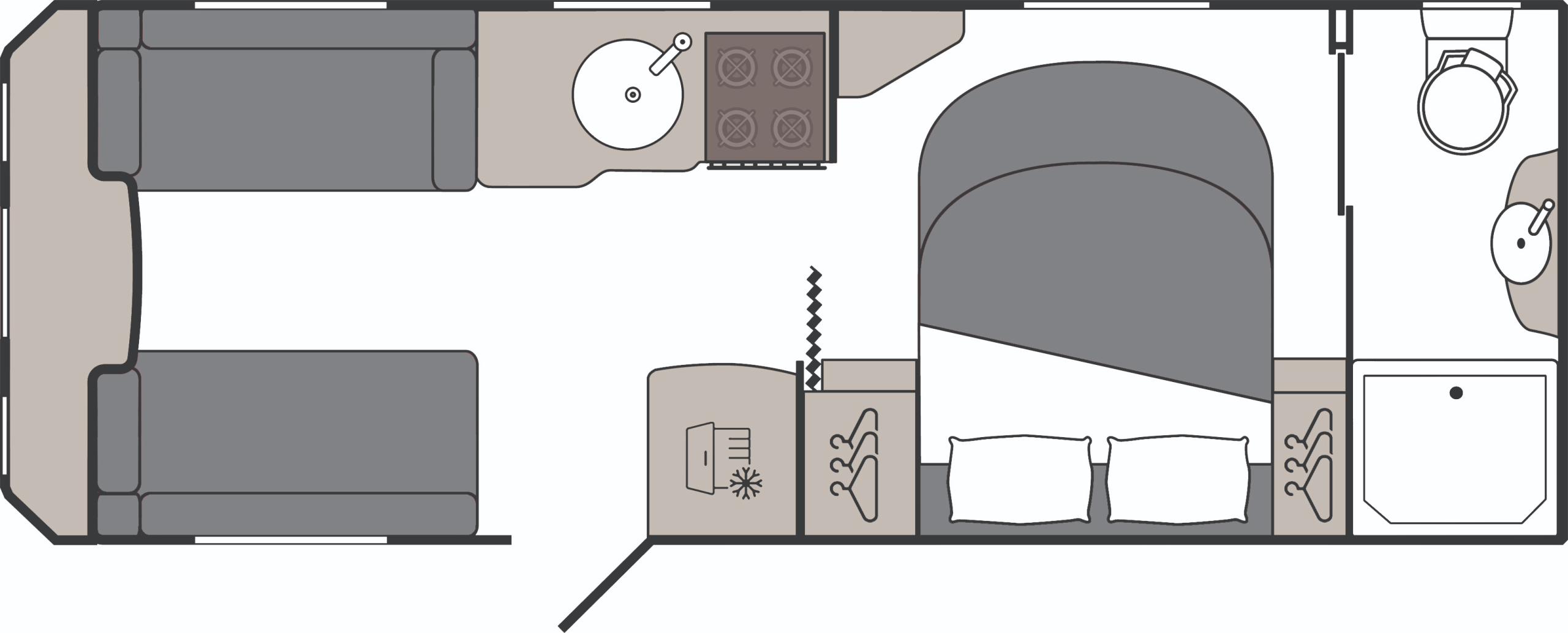
A fixed bed stays made up throughout your trip, giving you a permanent sleeping area without rebuilding the lounge every night. The main fixed bed caravan layouts are transverse island beds, inline island beds, fixed transverse doubles, French beds and fixed single beds. The right choice depends on who travels with you, how easily you both want to get in and out of bed, and how much living space you are prepared to give over to the bedroom.
What is a fixed bed?
A fixed bed is a permanent bed that stays in place during the day as well as at night.
That is different from a make-up bed, where the seats in a lounge or dinette are rearranged to create a sleeping area each evening. Many touring caravans offer both, using a fixed bed for the main bedroom and converting the front lounge into extra berths when needed.
The benefit of a fixed bed is convenience. Bedding stays in place, the bedroom is always ready and you do not need to clear the lounge before going to sleep.
There is a trade-off, though. A permanent bed occupies floor space all day, even when nobody is using it. A fixed-bed caravan may need to be longer or wider as a result, or give up some lounge space compared with a caravan that relies entirely on make-up beds.
That does not make fixed beds an automatic upgrade. Plenty of experienced tourers deliberately choose a shorter two-berth caravan with a make-up bed because they would rather have the larger lounge during the day.
The best layout is the one that works with how you actually tour, rather than the one with the biggest bedroom. You can see how the different approaches play out across the Coachman caravan collection.
The main fixed bed layouts
Bed terminology gets confusing quickly when you start comparing floorplans. Two fixed doubles can offer completely different access, storage and space around them depending on how they are positioned.
Transverse island bed
A transverse island bed runs across the width of the caravan, with the head against one side wall and access around the remaining sides.
Its biggest advantage is access. Both people can usually get in and out without climbing over one another, and there is room around the bed for making it and reaching wardrobes and storage.
That arrangement needs width. The mattress has to fit across the body while still leaving usable walkways around it, which is why transverse island beds work best in wider caravans. The 2027 Acadia 545 Xtra and 655 Xtra both use the layout, as does the Lusso III, where the bed sits in front of a rear washroom.
If this layout appeals, our guide to 8ft wide caravans explains what the extra width changes elsewhere in the caravan.
The downside is floor area. An island bed needs more of it than a double pushed against a wall, because you are giving up space for the bed and for the walkways around it.
Inline island bed
An inline island bed, sometimes called a longitudinal island bed, runs lengthways rather than across the caravan.
You still get access from both sides, so it shares many of the practical benefits of a transverse island bed. The difference is where the space goes. Running along the caravan uses less width around the mattress but more length, and space around the foot of the bed can be tighter depending on the floorplan.
The difference is more than terminology. The Acadia 545 is a useful real-world example, having been widened for 2027 and changed from an inline island bed to a transverse one.
Neither orientation is inherently better. When you compare them, look at the walkway around the foot and sides of the mattress rather than the bed dimensions alone.
Fixed transverse double
A fixed transverse double also runs across the caravan, but sits against the wall rather than being surrounded by access space. That makes more efficient use of the floorplan.
The compromise is that whoever sleeps nearest the wall has to climb over their partner to get out. If one of you regularly gets up during the night, that matters more than it appears on a floorplan.
For plenty of couples it is no problem at all, and in return the caravan can give more space to the lounge, kitchen or washroom while still offering a permanent double. It suits you if you want a fixed bed without the space demands of a full island arrangement.
French bed
A French bed is a fixed double positioned lengthways along one side of the caravan, with a cut-off corner at the foot of the mattress. That angled section frees up space for a walkway, a washroom entrance or adjacent furniture.
It is a useful compromise, giving you a permanent double without the floor area needed to walk around both sides of an island bed. The trade-off is access, since one side of the mattress sits against the wall.
French bed is a market term rather than a Coachman model category, and manufacturers and dealers describe similar floorplans in different ways. Always work from the layout diagram rather than the name.
Fixed single beds
Fixed single beds place two permanent mattresses in the bedroom, usually separated by a central walkway. For couples who tour regularly, they are one of the most practical layouts available.
Each person has independent access, nobody climbs over anybody, and getting up during the night causes far less disturbance. The gap between the beds also makes wardrobes and overhead lockers easier to reach, and the bed bases themselves usually provide useful storage.
In the 2027 line-up, the VIP 565 and Laser 865 Xtra both have two fixed single beds.
One point to check is whether the singles can be joined into a double. Some layouts offer an infill or extension for this, but it is not standard across the board, so confirm it on the specific model before you order.
Retractable and lift-up beds
A retractable fixed bed is different again. The mattress and base shorten or retract during the day to free up walking space in the bedroom, then extend to full sleeping length at night.
For 2027, retractable beds feature on the Acadia 545 Xtra, 575 Xtra and 655 Xtra, the VIP 545 and 575, and the Laser 575 Xtra, 845 Xtra, 855 Xtra and 875 Xtra.
That is not the same as a lift-up bed frame. Many fixed beds lift on gas struts to reach storage below, but the mattress stays the same size and the base simply lifts like a lid. Coachman uses gas-strut lift-up frames on fixed beds across its ranges, which makes the space underneath genuinely useful for bulkier touring equipment.
How to choose the right fixed bed layout
There is no single best caravan bed layout. A floorplan that works perfectly for one couple becomes frustrating for another after a week away. Start with the practical details.
Who travels, and how often?
If you tour for a few weekends each summer, making up a bed each night may not bother you. If you spend weeks away at a time, a permanent bedroom becomes far more valuable.
How important is independent access?
This is the biggest single difference between the layouts. Island beds and fixed singles let each person get in and out on their own. A French bed or a wall-mounted transverse double means one person crosses over the other.
Think about what happens at 3am, not just how the bedroom looks when it is dressed for a showroom.
What are you giving up?
Every fixed bed occupies space that could have gone somewhere else. A larger bedroom can mean a smaller lounge. Walk-around access adds length. An island bed needs clearance around the mattress. The question is not which bed is biggest, but which part of the caravan you most want to prioritise.
How useful is the storage?
Fixed beds usually sit above substantial storage, and Coachman uses lift-up, gas-strut frames on fixed beds across its ranges so you can reach it easily. Some models also offer external access. That storage partly offsets the floor space the bedroom takes, particularly if you carry outdoor furniture, bedding or other bulky kit.
What does the layout do to length and weight?
A permanent bedroom needs space, so fixed-bed caravans tend to be longer than equivalent make-up-bed layouts, and the larger ones can be heavier. Do not choose the bed and check the towing figures afterwards. Our guide to MRO, MTPLM and user payload explains the weight figures and why they matter.
How easy is the bed to make?
A small detail until you are doing it every morning. Can you reach the head of the mattress comfortably? Is there room to tuck a sheet down both sides? Does the bed retract, and will you extend it every evening? Lie on the bed when you view one, but also try reaching around it.
Fixed bed or make-up bed?
A fixed bed is not automatically better than a make-up bed.
A make-up bed lets the same part of the caravan do two jobs. During the day it is your lounge, and at night the seats convert into a double or singles. That can give you a shorter caravan with more living space relative to its size.
The compromise is the evening routine. Cushions need rearranging, bedding needs storing during the day and the bed comes apart each morning if you want the lounge back.
A fixed bed does the opposite. You give up permanent floor space and gain convenience, privacy and under-bed storage.
The 2027 VIP range shows both approaches. The VIP 460 has no fixed bed and uses the front lounge for sleeping, while the 545, 565 and 575 have permanent bedrooms.
For two people taking short breaks, the extra lounge space of a make-up-bed caravan may be worth more. For longer trips, shutting the bedroom door and leaving the bed made can matter far more. Neither is the upgrade. They are different ways of using a limited amount of space.
Fixed bed layouts across the Coachman ranges
Bed choice cuts across the Coachman price ladder, so you do not need to move to the highest range to get the layout you want.
The Acadia range is entirely fixed-bed for 2027. The 545 Xtra and 655 Xtra use retractable transverse island beds, the 575 Xtra has a retractable fixed double bed, and the family-focused 660 Xtra pairs its permanent double with extra sleeping space made up from the lounge and side dinette.Acadia range
The VIP range gives you the widest spread of sleeping arrangements. The 460 and 520 have no permanent bed, the 545 and 575 use retractable fixed doubles, and the 565 has two fixed singles.
The Laser range concentrates on four-berth fixed-bed layouts, with fixed doubles and island-bed arrangements across single and twin-axle models, and fixed singles in the 865 Xtra. Retractable beds feature on the 575 Xtra, 845 Xtra, 855 Xtra and 875 Xtra.
At the top of the collection, the Lusso range consists of four fixed-double layouts, all 8ft wide. The Lusso IV has a rear transverse island bed with a mid washroom, and the redesigned Lusso III uses a transverse island double in front of its rear washroom.
The useful approach is to settle on the bed layout first, then work out which range, size and specification gives you the version of it that suits you. If you are deciding between the first two ranges, our Acadia vs VIP comparison covers the other differences.
FAQs
What is a fixed bed caravan?
A fixed bed caravan has a permanent bed that stays available through the day rather than being made up from lounge seating each night. Fixed beds include island beds, transverse doubles, French beds and fixed singles.
What is a transverse island bed?
A transverse island bed is a fixed double positioned across the width of the caravan with access around both sides. It gives both people easier access than a double set against a wall, but it needs more floor space.
What is a French bed in a caravan?
A French bed is an offset fixed double running along one side of the caravan, usually with a cut-off corner at the foot. The angled section creates more space for a walkway or an adjacent washroom.
Are fixed single beds better than a double?
Not necessarily. Fixed singles suit you if you want independent access and would rather not disturb each other during the night. A double feels closer to a conventional bedroom and suits couples who prefer to sleep together. It is a personal choice rather than one layout being better.
Do fixed beds make a caravan heavier?
The bed itself does not tell you how heavy a caravan will be, but fixed-bed models are often longer and can be heavier because more body length, furniture and equipment are involved. Compare the individual caravan’s MRO and MTPLM rather than judging weight from the layout.
Can you convert fixed single beds into a double?
Some layouts allow fixed singles to be joined using an infill or bed extension, but it is model-specific and should not be assumed. Check the specification of the individual model before you buy.
Choosing your caravan bed in person
A floorplan tells you where the bed sits. It cannot tell you how easy it is to get around, or whether the mattress and bedroom feel right to you.
Once you know which layouts appeal, our guide to choosing a touring caravan covers the wider decision, including size, weight and touring style. Then find your nearest Coachman dealer and try the layouts for yourself. Sit on the bed, lie down, walk around it and look at the storage. Those few minutes will tell you more than another floorplan.